The short answer
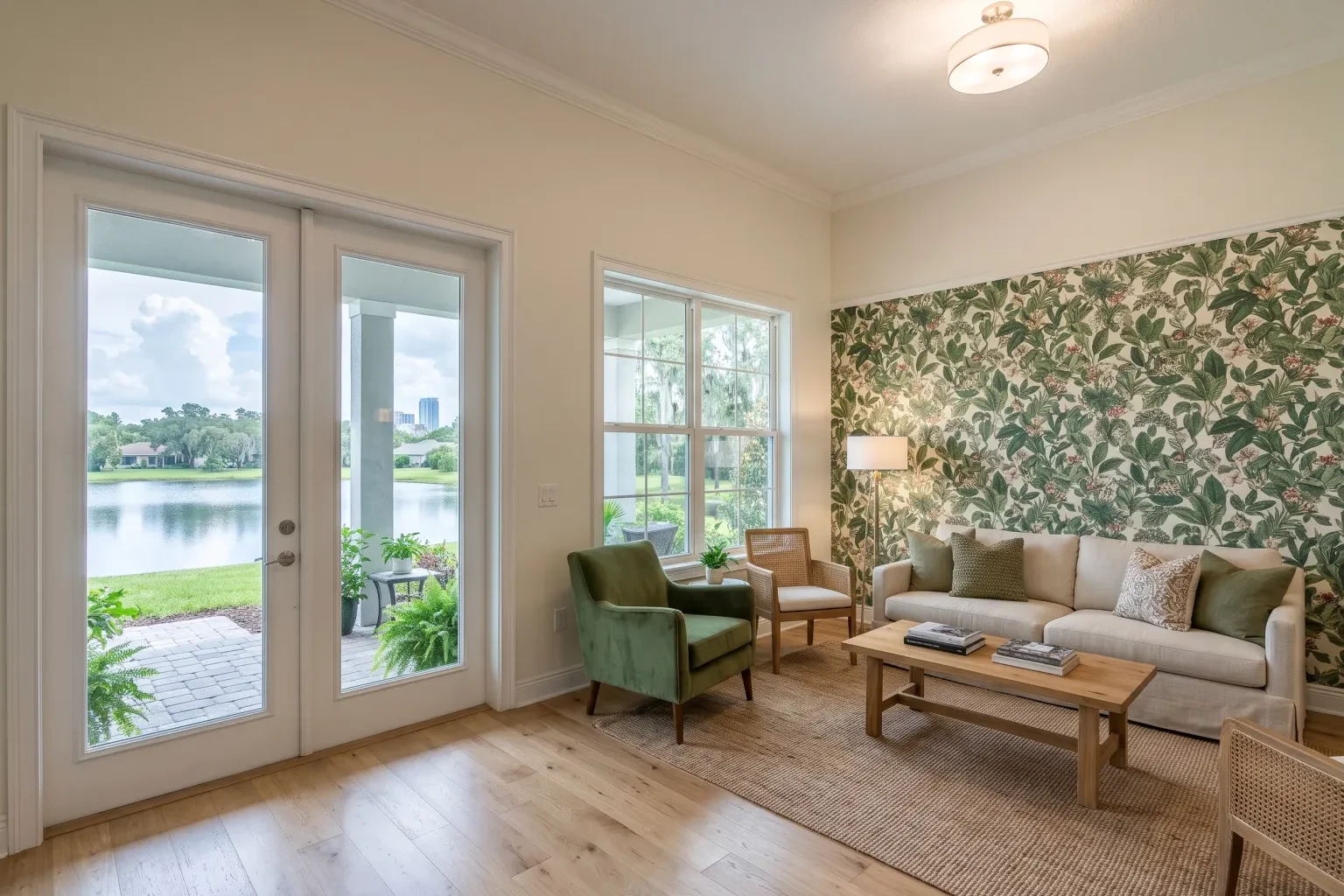
An accent wall works when a room needs one strong focal point rather than full coverage. We prepare and prime the single wall, center the pattern on what you see first, and hang it with tight, matched seams and clean trim lines.
One papered wall can change how a whole room feels without committing every surface to a pattern. An accent wall gives a bedroom a focal point behind the headboard, makes a long open-plan living area feel anchored, or turns a plain dining nook into the spot guests remember. Because all the attention lands on a single surface, the details matter more than usual: a crooked first strip, a visible seam or a pattern that breaks awkwardly at the ceiling is impossible to miss. We install accent walls for homeowners across Orlando and the surrounding towns, and this page walks through how we decide whether one suits your room, how we prepare the wall, how the paper goes up and what to expect afterward.
Is a Single Feature Wall the Right Call?
Accent walls shine in rooms where one surface already pulls the eye. Think of the wall behind a bed, the far end of a hallway, the wall a sofa faces, or the backdrop to a dining table. In those spots, a bold print or rich texture reads as intentional rather than busy.
They suit Orlando's open floor plans especially well. Many newer two-story homes have great rooms where kitchen, family area and dining space blend together, and a papered wall helps define one zone without boxing it in. In older concrete-block ranch homes, a feature wall can bring character to a room with modest trim and low ceilings.
A single wall is less convincing when the room has no natural focal point, when every wall is broken up by windows and doors, or when the chosen pattern is so quiet that it disappears on its own. In those cases, we may suggest a different wall, a full room or a ceiling instead.
- Good candidates: headboard walls, fireplace or TV walls, dining backdrops, entry or stair landings
- Weaker candidates: walls interrupted by several openings, or surfaces that sit mostly behind furniture
- Consider light: a wall opposite large sliders gets bright afternoon sun, which can fade some natural fibers over time
Getting the Wall Ready
Prep for a single wall is just as thorough as for a full room, and arguably more important. We remove outlet covers and switch plates, pull nails and anchors, and fill holes with a setting compound. Cracks along drywall joints get taped and filled. On painted block walls, we smooth the mortar lines so they will not ghost through thinner papers.
Next we check the paint. Glossy or semi-gloss finishes get scuffed or sealed so paste can grip, and chalky or peeling areas are scraped back to a sound surface. If the wall has a light orange-peel texture, as many newer subdivision homes do, we decide between sanding it down or applying a thin skim coat, depending on the paper's thickness.
Last comes primer. We use a wallpaper primer suited to the product: an acrylic primer for most papers and vinyls, and sometimes a pigmented one when a thin or light-colored paper could let a dark wall show through. The primer also makes future removal far easier, which matters if you like to change accent colors every few years.
How We Hang an Accent Wall
With a single wall, the layout decision is everything. Here is the order we work in:
- Measure and plan: we measure the wall's width and height and note where the pattern's main motif should sit, usually centered on the bed, fireplace or sightline from the doorway
- Mark a plumb line: walls in older homes are rarely perfectly vertical, so we work from a laser or plumb line rather than the corner
- Set the repeat height: we decide where the motif lands near the ceiling so it is not cut in half at the top edge, the place your eye checks first
- Cut and book: strips are cut with extra length for trimming, pasted or activated according to the manufacturer, and booked to relax when the paper requires it
- Hang and match: each drop is aligned to the previous one at the pattern match, butted tight and smoothed from the center outward to push out air
- Roll the seams: a seam roller sets the edges without crushing embossed or textured papers
- Trim: we cut at the ceiling, baseboard and corners with a fresh blade and a broad knife, then wipe away paste from adjoining surfaces
What Shapes the Cost of an Accent Wall
Because only one wall is involved, people expect a simple flat figure, but the work varies widely from wall to wall. The main factors we look at are:
- Wall condition: smooth, sound paint needs little prep, while texture, damage or old adhesive adds hours
- Paper type: prepasted papers, paste-the-wall products, heavy vinyls, grasscloth and peel-and-stick all handle differently
- Pattern repeat: a large drop match wastes more paper and takes longer to align
- Wall size and ceiling height: tall great-room walls need staging and careful handling of long strips
- Obstacles: windows, outlets, built-ins and angled ceilings mean more cuts
Looking After Your Feature Wall
For the first few days, keep the air conditioning running so the adhesive cures in steady, dry air; Orlando's humid summer afternoons are exactly when a closed-up house gets damp. Avoid hanging art or pushing furniture against the wall until it has fully dried.
After that, dust it occasionally with a soft cloth or a vacuum brush attachment. Washable vinyls can be wiped with a damp sponge and mild soap, while natural papers like grasscloth should only be dusted. If an edge ever lifts, a dab of seam adhesive pressed down with a clean roller usually fixes it, and we are happy to show you how.
Accent Wall Installation by city
- Accent Wall Installation in EdgewoodLocal service & repairs
- Accent Wall Installation in Belle IsleLocal service & repairs
- Accent Wall Installation in WindermereLocal service & repairs
- Accent Wall Installation in Lake Buena VistaLocal service & repairs
- Accent Wall Installation in Winter ParkLocal service & repairs
- Accent Wall Installation in KissimmeeLocal service & repairs
- Accent Wall Installation in EatonvilleLocal service & repairs
- Accent Wall Installation in MaitlandLocal service & repairs
- Accent Wall Installation in OcoeeLocal service & repairs
- Accent Wall Installation in Bay LakeLocal service & repairs
- Accent Wall Installation in Winter GardenLocal service & repairs
- Accent Wall Installation in Sky LakeLocal service & repairs