The short answer
Grasscloth works best in dry, low-traffic rooms like living rooms, dens, bedrooms and offices, where its texture can show without facing splashes or steam. We prime the walls with a pigmented wallcovering primer, paste and book each panel by hand, and accept visible seams as part of the natural material rather than trying to hide them.
Grasscloth is woven from plant fibers such as sisal, jute, arrowroot and seagrass, then laminated to a paper backing. No two strands catch light the same way, which is exactly why people love it and exactly why it punishes a careless hand. Paste stains it, rough handling frays it, and a wall with a lingering moisture problem can leave tide marks in the weave. Specialist Wallpaper Installer hangs natural fiber coverings for homeowners in Orlando and the surrounding towns, and this page walks through how we decide if a room suits it, how the walls get ready, how each panel goes up, what drives the scope of a job, and how to live with the finished surface.
Rooms where natural fiber makes sense
Think of grasscloth as a textile, not a paper. It absorbs sound a little, softens a large flat wall, and adds warmth to rooms that feel cold or echoey, such as a vaulted family room in a newer two-story stucco build. It also covers minor wall flaws better than a flat print because the weave breaks up the eye.
Where it struggles is anywhere water lands on it. Our summers bring heavy humidity and nearly daily afternoon storms, and any room that stays damp, sees splashing or gets steam from a shower will slowly discolor natural fibers. We usually steer homeowners away from it in full bathrooms, laundry rooms, kitchens behind the sink and walls that open directly onto a screened pool enclosure.
Good candidates we regularly suggest:
- Accent walls behind a bed or a sofa
- Dining rooms that are used for meals, not as a pass-through
- Home offices and libraries where the texture frames shelving
- Powder rooms without a shower, provided ventilation is decent
- Ceilings in tray or coffered designs, where nobody touches them
Getting the wall ready before any fiber touches it
We start by checking the wall with a moisture meter, especially on exterior walls of older concrete-block ranch houses, where block can wick humidity inward after weeks of summer rain. A wall that reads damp gets addressed first, because grasscloth will reveal that moisture as brown staining within weeks.
Next comes surface repair: filling nail holes, skimming over heavy orange peel or knockdown texture, sanding patches flat and removing any old wallpaper residue. Grasscloth is forgiving of small bumps, yet a ridge running behind a seam will cast a shadow line.
Then we apply a pigmented, acrylic wallcovering primer. Pigment matters here, because many grasscloths are slightly translucent. A primer tinted close to the color of the backing keeps a patched spot or a dark old paint color from ghosting through the weave. The primer also gives the paste a consistent surface and makes eventual removal far easier.
How we hang it, panel by panel
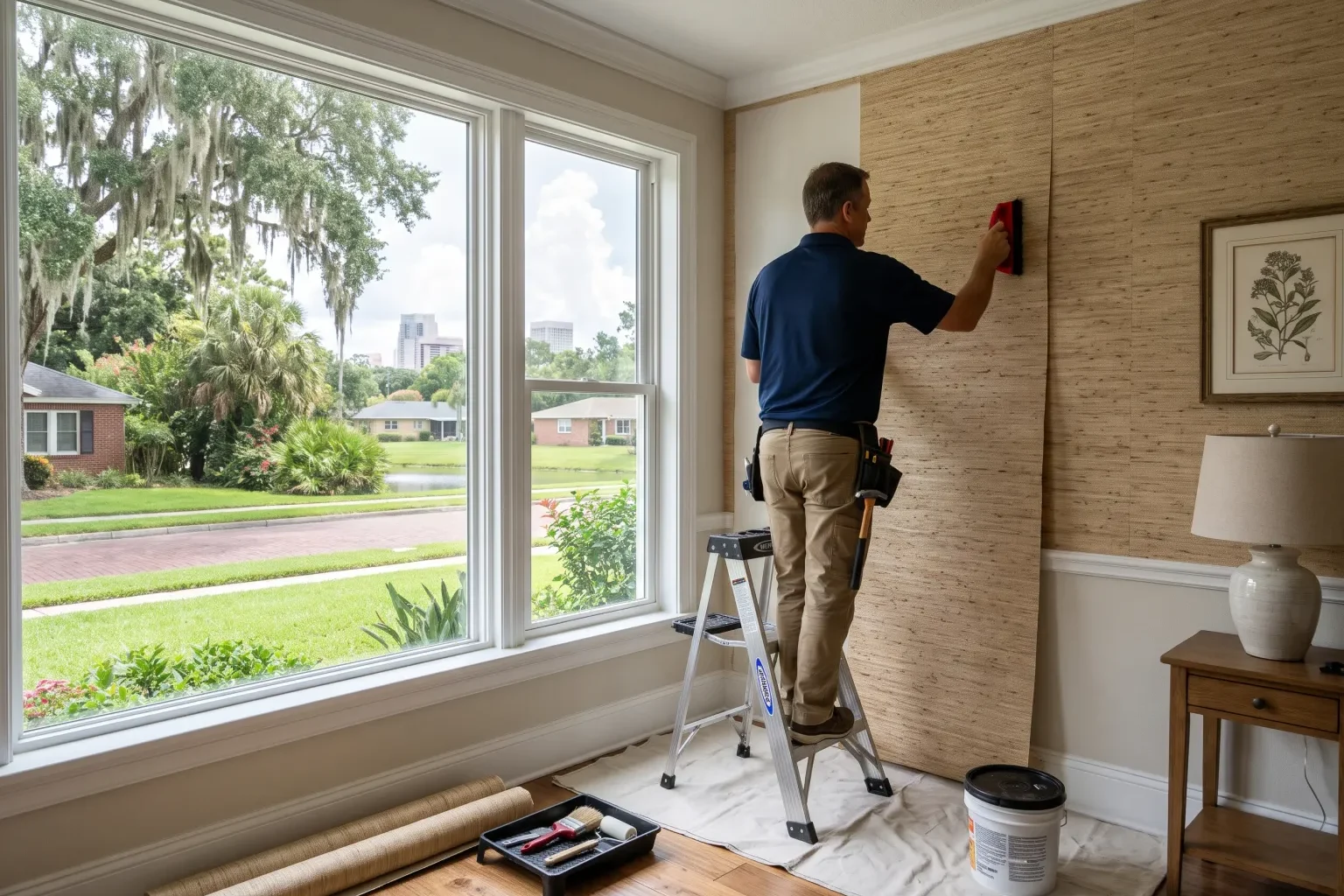
Hanging grasscloth is slower and more deliberate than hanging printed paper. Here is the order we follow on a typical wall.
- Measure and plan: we measure each wall, account for windows and doors, and lay out where seams will fall so no narrow sliver ends up in a corner or beside a focal point.
- Inspect the rolls: we unroll and check every bolt in good light for shade variation, flaws and run numbers before cutting, since color shifts between rolls are normal with natural dyes.
- Reverse alternate panels: many manufacturers recommend hanging every other strip upside down so shading at the edges balances out. We follow the instructions printed for that specific product.
- Paste by hand: we roll paste onto the back with care to keep it off the face, then book the strip, folding it paste side to paste side, and let it relax for the time the manufacturer specifies.
- Set the seam: panels are butted, never overlapped, and pressed with a soft brush or a plastic smoother rather than a seam roller that could crush or burnish the fibers.
- Trim clean: we trim at ceiling, baseboard and casing with a fresh blade on every few cuts so the fibers sever cleanly instead of tearing.
What shapes the scope and cost of a grasscloth job
We quote each project after seeing the space, because several factors change how much labor and material it takes. Wall condition is often the biggest one: a smooth, sound wall needs only primer, while textured or patched drywall may need a full skim coat first.
The product itself matters too. Fine, tight weaves with a paper backing behave differently from loose, chunky sisal, and some imported grasscloths arrive with wider shade variation that requires more careful sorting. A covering with a printed motif over the fiber adds pattern repeat and matching time, which raises waste.
Room size and ceiling height round it out. Tall stairwells and two-story foyers need scaffolding or extension planks, and rooms with many windows, outlets and corners mean more individual cuts.
Living with grasscloth after it goes up
Natural fiber is not scrubbable. For routine care, dust it gently with a soft brush attachment on a vacuum every few months. If something lands on it, blot it immediately with a dry white cloth and avoid rubbing, which pushes stains deeper and roughens the weave.
Keep humidity under control. Running the air conditioning steadily through the wet months protects the fibers, and so does keeping a dehumidifier handy if a storm knocks out power for a while during hurricane season. Direct afternoon sun through a west window can fade some dyes over time, so sheer curtains or UV film are worth considering.
Small snags can usually be tucked back with a dab of seam adhesive. Save a leftover piece from the original rolls, since a later batch is unlikely to match the shade exactly.
Grasscloth Wallpaper Installation by city
- Grasscloth Wallpaper Installation in EdgewoodLocal service & repairs
- Grasscloth Wallpaper Installation in Belle IsleLocal service & repairs
- Grasscloth Wallpaper Installation in WindermereLocal service & repairs
- Grasscloth Wallpaper Installation in Lake Buena VistaLocal service & repairs
- Grasscloth Wallpaper Installation in Winter ParkLocal service & repairs
- Grasscloth Wallpaper Installation in KissimmeeLocal service & repairs
- Grasscloth Wallpaper Installation in EatonvilleLocal service & repairs
- Grasscloth Wallpaper Installation in MaitlandLocal service & repairs
- Grasscloth Wallpaper Installation in OcoeeLocal service & repairs
- Grasscloth Wallpaper Installation in Bay LakeLocal service & repairs
- Grasscloth Wallpaper Installation in Winter GardenLocal service & repairs
- Grasscloth Wallpaper Installation in Sky LakeLocal service & repairs